Cookie Consent by Free Privacy Policy Generator Lab | Igor Moiseev

Lab

Research programs and their outputs. Each program asks one question, pre-registers its hypotheses with the result that would kill them, runs the experiments in public, and reports the verdict — negative results included.

Every program follows the same loop: literature → candidate edge & caveats → hypothesis with a kill criterion → experiment → verdict → next hypothesis. A program is read from its Part 1, which states the question and the verdicts up front; the remaining outputs hang under it. Parts are the narrative posts, appendices the theory background, articles the formal statements and proofs, and the code reproduces every number.

Scoreboard: ✓ confirmed ✗ refuted △ partial / split ○ pending

Active Program D 8 parts · 5 appendices · 1 article

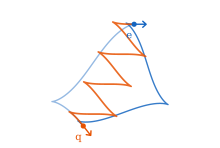
The Geometry of Forbidden Directions

QuestionWhere a physical field forbids a direction of motion, can sub-Riemannian geometry read the field's local structure?

OutcomeFor magnetic fields, yes: the law Q = d + k + 2 holds in 2D and 3D, and the caustic reads the field gradient — tested on the Sun, Earth's magnetosphere and Jupiter.

  • ✓Law 2D Q = d + k + 2
  • ✓Moduli the caustic reads the field gradient
  • ✓Law 3D Q = k + 5
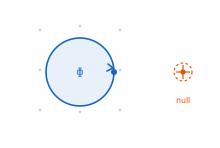
  • ✓Nulls agrees with the standard finder (a consistency check)

FrontierDo finer caustic invariants recover the null type (radial vs spiral) the growth vector discards?

Grew out ofFrom Caustics to Groups

Start here — Part 1 →
Complete Program C 4 parts · 6 appendices

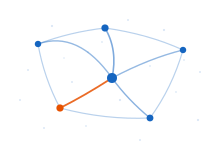
From Caustics to Groups

QuestionGiven an observed field of caustics, can you infer the sub-Riemannian Lie group that produced it?

OutcomeYes on synthetic data — identifiable, discriminable, with a mapped aliasing structure — and calibrated silence where no group exists; gravity turns out to carry no sub-Riemannian structure at all.

  • ✓H1 identifiability
  • ✓H2 discrimination
  • ✓H3 rigidity / aliasing
  • ○H4 in-the-wild inference (synthetic confirmed, real DW-MRI pending)

FrontierReal DW-MRI inference (needs credentialed data).

Start here — Part 1 →
Complete Program B 3 parts · 5 appendices

Geometry of the Cosmic Web

QuestionIs the orientation-lifted geometry of visual completion a better instrument for finding cosmic filaments, or even part of the physics that builds them?

OutcomeMostly no — and usefully so. What survived: a cleaner anisotropy descriptor and an unplanned one-rule transport model, brake sideways at the web.

  • ✗H1 lift beats the curvature detector
  • ✗H2 tidal frame sharpens detection
  • △H3 webs sit on real mass and hot gas
  • ✗H4 matter travels along the geodesics

Grew out ofGeometry of Seeing

Start here — Part 1 →
Complete Program A 4 parts · 5 appendices

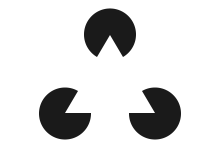
Geometry of Seeing

QuestionHow does the visual cortex complete contours that are not there, and what exactly are the optimal curves it draws?

OutcomeExposition: V1 as a contact bundle on SE(2), elastica via Jacobi elliptic functions, Maxwell strata — ending on Sachkov's exact cut time and the question it leaves open beyond SE(2).

FrontierCut = first Maxwell time is proven for SE(2); a general theorem for left-invariant SR problems remains open.

Start here — Part 1 →

All formal articles

Complete statements and proofs behind the programs, with a ledger of what is proven, measured, and conjectured. Browse the articles index →