Grow your own spiral galaxy
$m\approx\dfrac{\kappa^2R}{2\pi G\Sigma X},\quad X\approx2$
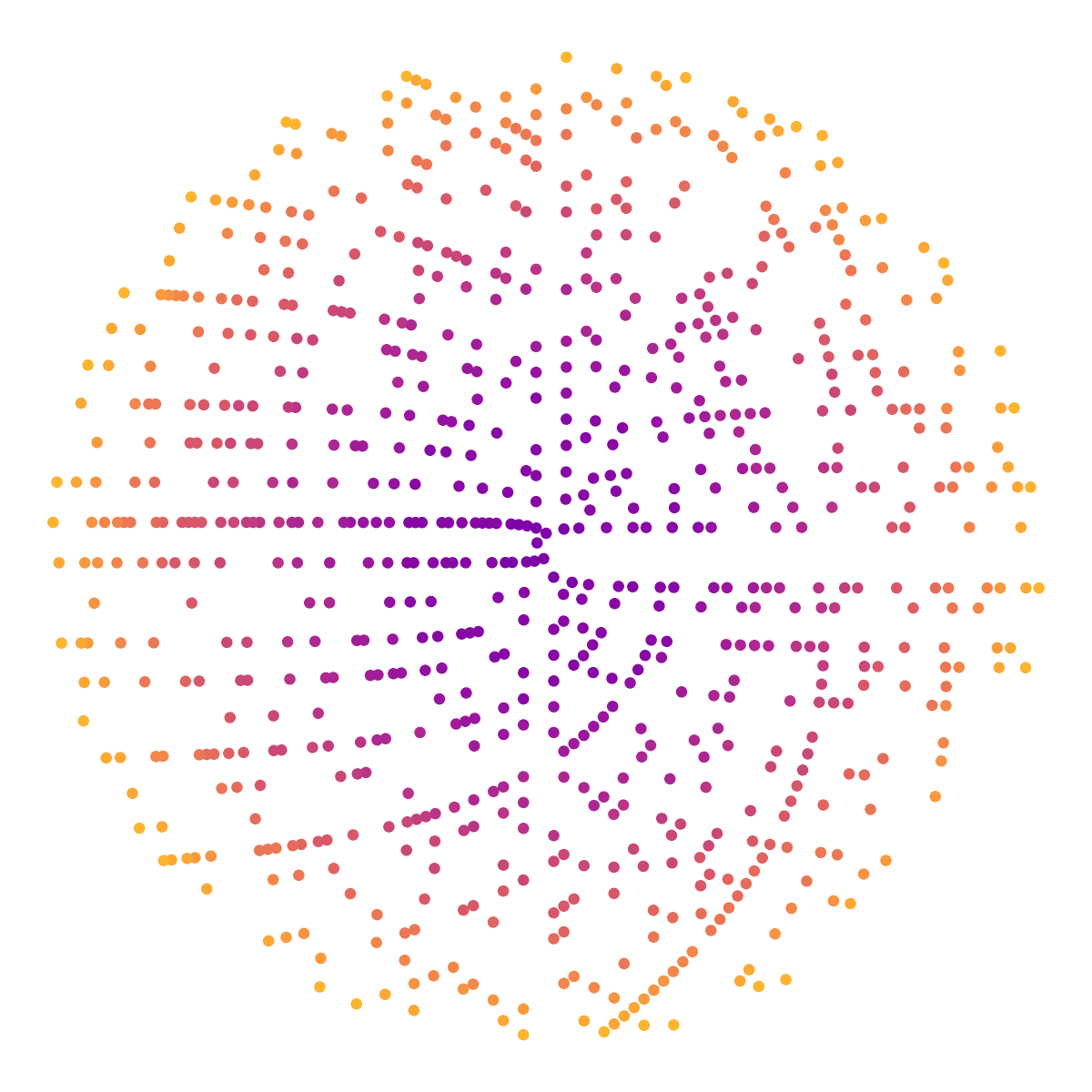
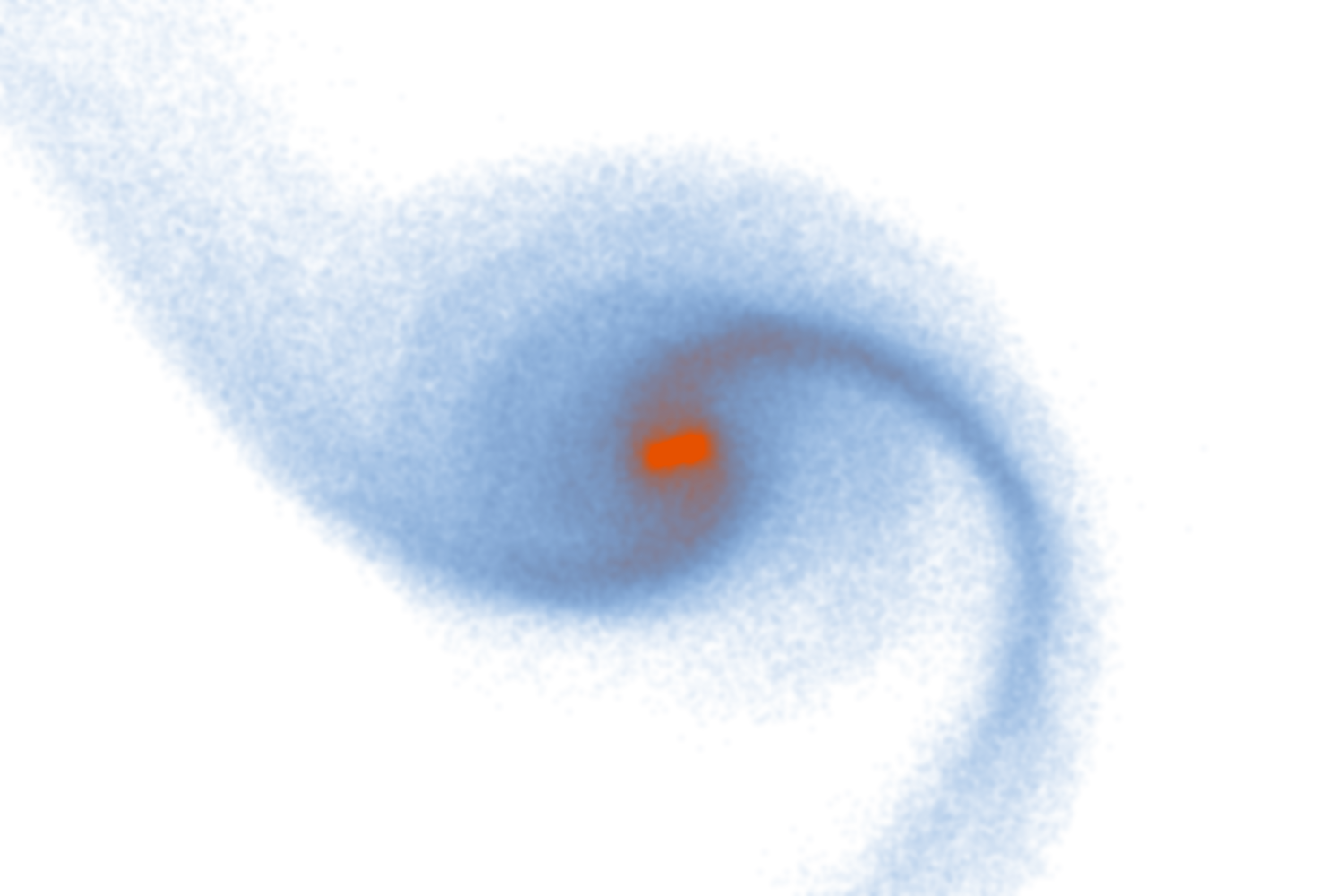
A live N-body disc in your browser: light discs, massive discs, bars, tidal encounters and the winding problem

I’m Igor, an applied mathematician. I write here about geometry, optimal control, formal proofs, machine learning and software engineering, mostly as research series with their equations, figures and code.
$m\approx\dfrac{\kappa^2R}{2\pi G\Sigma X},\quad X\approx2$
A live N-body disc in your browser: light discs, massive discs, bars, tidal encounters and the winding problem
$z_p=\sqrt p\,e^{2\pi i\beta p},\quad \beta=1/\varphi^2$
Golden angles, quadratic tracks, and the divisibility behind the patterns
739 + 1,359 declarations · 1,277,896 shared nodes
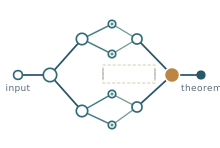
Complete compiled proof graphs from two Lean corpora, their shared structure, and the limits of correspondence with a mathematical article.
2,465 infrared counterparts · 12.8% of 19,219 clumps
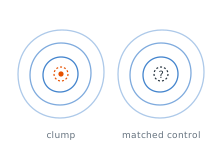
Infrared counterparts identify a useful search population. What can multiple surveys establish about the objects hidden inside dust clumps?
$\dot q=u_1X_1+u_2X_2,\quad X_1=\cos\theta\,\partial_x+\sin\theta\,\partial_y$
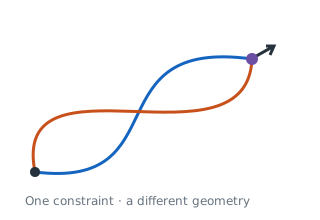
An interactive guide to the geometry of motion in the plane: from a simple constraint to the pendulum, competing routes, and the complete shortest-path solution.
$\operatorname{sn}^2(\psi+p)=r(p)$
One research program, three questions: when a path loses local optimality, where nearby paths focus, and how many paths reach the same position and heading. Follow the pendulum, explore the conjugate locus, and count the inverse images.
$\delta(\varepsilon)=1-\tfrac{2}{\pi}K(2\varepsilon),\quad \varepsilon<\tfrac12$
A holonomy growth law and exact magnetic identities hold under stated assumptions. Matched estimator comparisons favour standard fits, and a purported magnetospheric null census fails its domain audit.