The audit, first
| Candidate | Literature check | Outcome |
|---|---|---|
| No force-free field hosts a spiral null | the MHD-relaxation literature (Fuentes-Fernández & Parnell) already knew this dynamically | downgraded: our 3-line pointwise proof is a clarification; what remains ours is the audit corollary, correctly scoped — a spiral null in any smooth force-free (bounded-α) extrapolation catalogue is a numerical force-free violation (non-force-free and data-driven MHD extrapolations are outside the theorem) |
| The gyro-caustic series $\delta(\varepsilon)$ | guiding-centre theory has the machinery (Littlejohn, Brizard), not the statistic | survives → hardened below |
| The scale-crossover pair read-out | null detection is pointwise; multifractal “local dimension” is a different object | survives the library — so we raced it against the strongest rival we could build |
The claim that hardened: the refocusing average is an elliptic integral
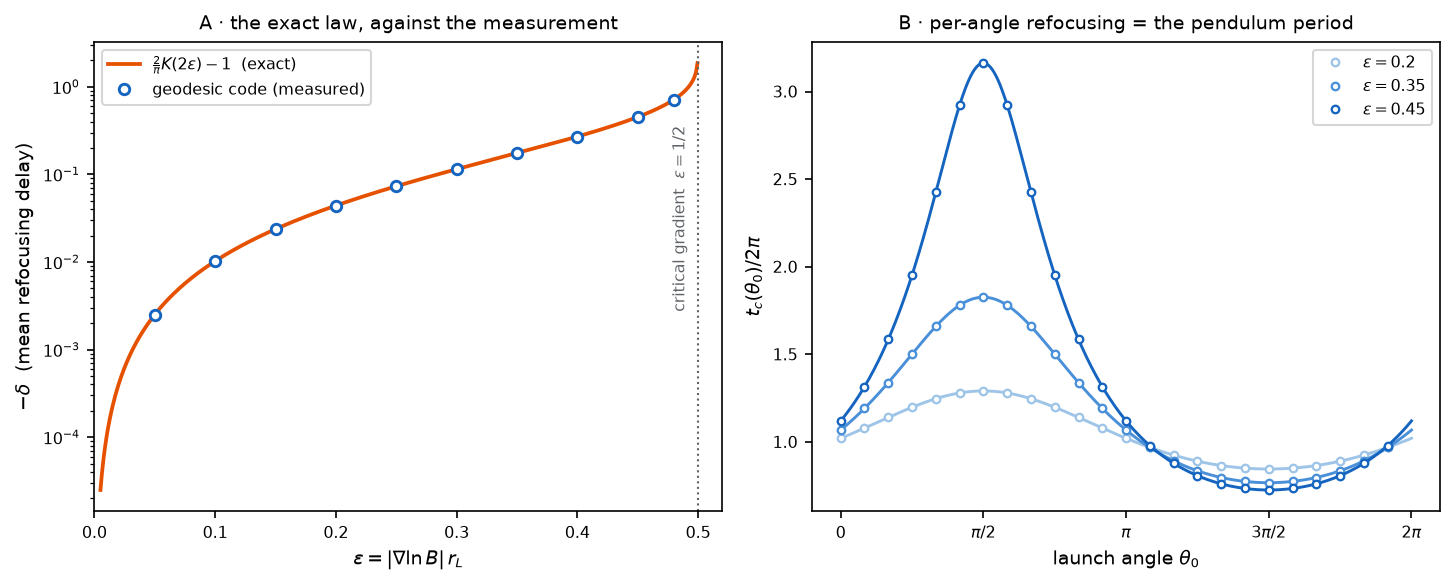
Part 3 measured how a magnetic-field gradient delays the refocusing of Larmor orbits on the exponential profile (general one-dimensional profiles carry the $1-\tfrac34\beta$ calibration, and past $\beta = \tfrac43$ the leading-order effect flips sign): $\delta = -\varepsilon^2 - c_4\varepsilon^4 - \cdots$ with $\varepsilon = \lvert\nabla\ln B\rvert\,r_L$. Chasing $c_4$ to precision ($2.2497 \pm 0.0009 = 9/4$, refuting the $5/2$ a coarse fit once suggested) exposed a coefficient pattern — squared normalised central binomials — that is the fingerprint of one classical function. The whole series collapses into two symbols:
\[\boxed{\;\delta(\varepsilon) \;=\; 1 - \frac{2}{\pi}\,K(2\varepsilon)\;}\]with $K$ the complete elliptic integral of the first kind (modulus convention). Nothing here is asymptotic hand-waving; every link is checked at referee grade:
- The mechanism is a one-line integral of motion. Along a geodesic, $\dot\theta = e^{\varepsilon x}$ and $\dot x = \cos\theta$ give $d\dot\theta/d\theta = \varepsilon\cos\theta$, hence $\dot\theta = 1 + \varepsilon(\sin\theta - \sin\theta_0)$ — the angular dynamics is integrable, a pendulum in disguise.
- Per launch angle, the refocusing time equals the $\theta$-period $2\pi\big[(1-\varepsilon\sin\theta_0)^2-\varepsilon^2\big]^{-1/2}$ — an identification verified against the Jacobian-zero conjugate times of the geodesic integrator to $\lesssim 10^{-7}$ relative, every angle, up to $\varepsilon = 0.45$; formally open (and it fails off the exponential profile), so every “refocusing” reading of the period formulas below is conditional on it.
- The launch-angle average equals $\tfrac2\pi K(2\varepsilon)$ — verified symbolically term-by-term through $O(\varepsilon^{12})$ (computer algebra) and numerically to $4\times10^{-9}$ or better over $\varepsilon\in[0.05, 0.45]$ ($\le 10^{-10}$ for $\varepsilon \le 0.25$) through the full measurement pipeline.
research/preferred-directions/scripts/run_p5_series.py,
render_closed_form.py.
The divergence is physics, not pathology. As $\varepsilon \to 1/2$ the mean
$\theta$-period diverges — that is the theorem — and the measured conjugate times ride
it: the slowest launch direction ($\sin\theta_0 = 1$) has period
$T = 2\pi/\sqrt{1-2\varepsilon}$, and its measured $t_c$ matches at $\varepsilon = 0.45$
and $0.49$. Above
the critical gradient the picture is sharper than a blanket
no-refocusing claim (a referee-prompted probe measured it): for exactly the launch band
$\sin\theta_0 \ge (1-\varepsilon)/\varepsilon$ no conjugate point is detected within
the integration window of eight reference periods — 9 of 64
angles at $\varepsilon = 0.52$, 13 of 64 at $0.55$ — while every other angle keeps one,
still equal to its period to $5\times10^{-5}$
(run_r6_supercritical.py; finite-horizon evidence, not a proof those orbits never
refocus later). When the field changes by more than half across a Larmor radius:
the mean period diverges — a theorem; the slowest orbits stop refocusing on every
horizon we integrated — a finite-horizon measurement; and that the launch-averaged
caustic opens with them is exactly as strong as the period identification. A
critical gradient, delivered by a textbook special function. (The two steps a referee
should still demand, stated plainly: a formal proof that the conjugate time equals the
period for this integrable family — our evidence is $\lesssim 10^{-7}$ numerics — and one final
literature pass on gyro-period integrals in exponential field profiles.)
The claim that lost: the crossover, demoted by its own race
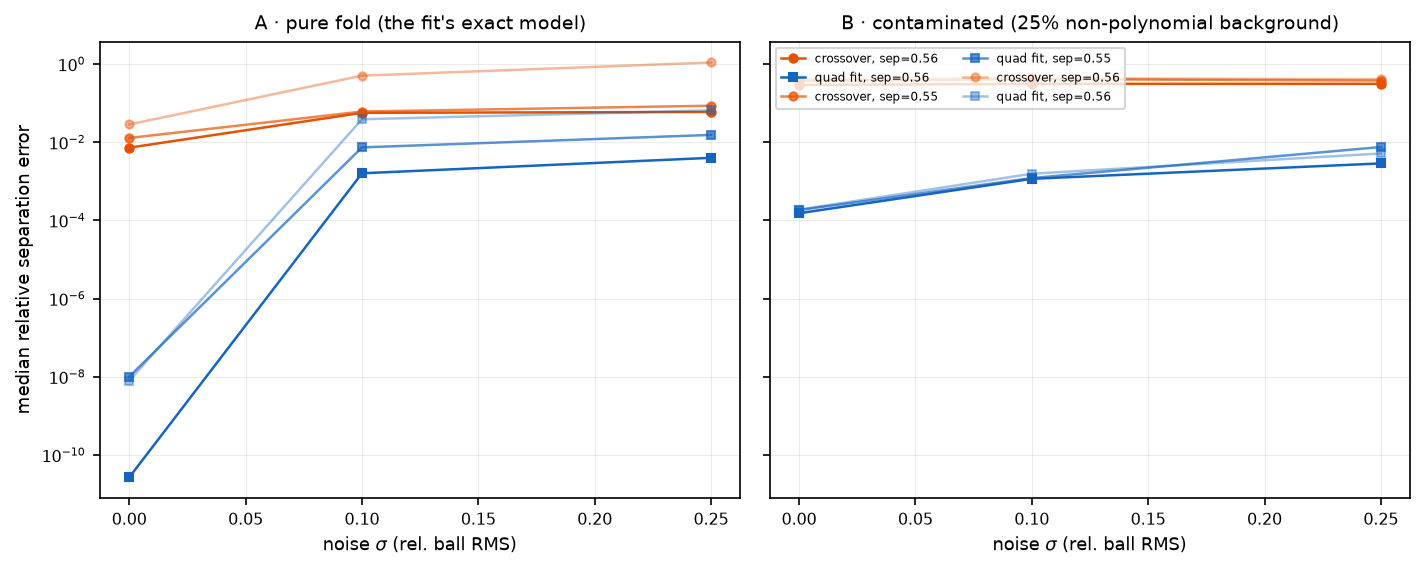
Part 6’s scale crossover reads an unresolved null pair’s separation from one point — an observable with no analogue in the null-detection literature. No analogue does not mean no competitor. The obvious statistical rival: fit a divergence-free quadratic field to the same noisy grid and root-find it. We pre-registered the protocol and the demotion rule, then ran it: same gridded field to both sides, the crossover building its own potential from the data, a clean leg and a contaminated leg, three separations, three noise levels.
research/preferred-directions/scripts/run_p5_race.py.
What survives the demotion, stated precisely: $Q = 7$ at the symmetric fold’s degenerate point ($\nabla\mathbf B \equiv 0$ normal form) is a statement about the field’s intrinsic geometry, not an estimate in competition — with Part 6’s correction attached: a generic rank-2 fold keeps a nonzero 1-jet and reads $Q = 6$; the 2/3/4 plateau dictionary remains the correct meaning of uniform/null/degenerate; and the dilation collapse remains the right mental model of what an unresolved pair is. But for measuring a separation on data, fit and root-find. This is the second time the series has measured this moral — classification fell to the linear fit in Part 5 the same way.
The hunt that came back empty: a fold on the real Sun
The transition state’s cleanest real-data signature would be a null pair being born in a flux-emergence region. We fetched eight real HMI frames tracking AR11158 — the textbook emergence region — from its early emergence to ten hours past its X2.2 flare (2011-02-13 00:00 → 02-15 12:00 UT), and ran the census on every frame.

artifacts/hmi_scale.json), so each frame is $\approx 230$ Mm
across; ★ =
detected coronal nulls of the potential extrapolation). The census reads
0,0,0,(1),0,1,0,2: a young bipole is a simple arcade with no coronal
nulls at all, and nulls appear as the region builds the multipolar structure that
makes it flare-capable. Pipeline:
research/preferred-directions/scripts/run_p5_sequence.py.
No fold birth was captured. The final pair is same-signed, whereas fold-born pairs have opposite topological degree. The eight-frame, window-sensitive potential extrapolation cannot establish a relation between null count and flare capability. An apparent annihilation from the first window placement disappeared after recentring and was discarded. These are negative results, not a new solar complexity index.
What stands after review
| Claim | Status after the litmus tests |
|---|---|
| $Q = d+k+2$, tested $k = 0,1,2$ in 3D; $Q=7$ at the symmetric fold, $Q=6$ at a generic rank-2 fold | stands as corrected by Part 6’s certified collision — intrinsic geometry, no estimation rival |
| $\delta = 1 - \tfrac2\pi K(2\varepsilon)$ (period average); critical gradient $\varepsilon = 1/2$ | proven as a period-average identity; the closed form verified to $4\times10^{-9}$ or better; its caustic reading (Conjecture A) agrees to $\lesssim 10^{-7}$, formal step still open |
| Force-free ⇒ radial-only; magnetotail ⇒ 79 spirals | theorem stands; the census half is retracted — Part 6’s boundary audit puts every T96 census null it tested outside the model’s own magnetopause and finds none inside, so no valid interior spiral example survives |
| Crossover as pair-metrology tool | demoted by pre-registered race; survives as concept |
| Type classification, pair metrology | belong to statistical fits — measured twice |
| Fold birth on the real Sun | not caught; sparse, window-sensitive extrapolation |
The matched comparisons favour statistical fits for null type and pair separation. The surviving analytical identities remain distinct from those failed estimator claims.
Glossary
- $K(k)$ — complete elliptic integral of the first kind, $\int_0^{\pi/2} d\phi/\sqrt{1-k^2\sin^2\phi}$ (modulus convention).
- Critical gradient — $\varepsilon = 1/2$: the value of $\lvert\nabla\ln B\rvert\,r_L$ at which the mean $\theta$-period diverges (theorem) and the slowest launch angle loses its finite period; its caustic reading — the mean refocusing time diverging — is conditional on the period identification (above it, measured: only the band $\sin\theta_0 \ge (1-\varepsilon)/\varepsilon$ shows no conjugate point within the finite integration window; the rest keep $t_c = T$).
- Pre-registered rule — the verdict criterion written into the phase charter before the experiment ran; the race’s demotion rule is one.
- Same-signed pair — two nulls whose spine eigenvalues share a sign; cannot be fold-born (degree conservation), hence the emergence verdict.
Reproduce
cd research/preferred-directions
../cosmic-web/.venv/bin/python scripts/run_p5_series.py       # the period-average law, 4 checks
../cosmic-web/.venv/bin/python scripts/render_closed_form.py  # its figure
../cosmic-web/.venv/bin/python scripts/run_r6_supercritical.py # above the critical gradient
../cosmic-web/.venv/bin/python scripts/run_p5_race.py         # the race (~75 min)
../cosmic-web/.venv/bin/python scripts/fetch_sequence.py      # 8 real HMI frames
../cosmic-web/.venv/bin/python scripts/run_p5_sequence.py     # the emergence census
Charter and reports: docs/PROGRAM-P5-litmus.md, T1-race.md, T2-closed-form.md,
T3-emergence.md.