When several people and their AI agents investigate the same question, the work quickly spreads across conversations, scripts, tables and drafts. A useful result can become difficult to trace: which question produced it, what data were used, which assumptions remain open, and who checked it?
Bistro Research brings those pieces into a shared project. Maintainers define questions and tasks. Contributors work with their own agents and compute. Results arrive with scripts, claims, sources and a write-up, then pass through review. Readers can follow the record from the question to the evidence and see how far each result has been checked.
The central design choice is to keep several states separate: a result can be recorded, reviewed, re-executed, signed or explained. Each describes a different act. A polished explanation and a passing script answer different questions.
Public projects can be read without an account. Their pages expose findings, open caveats, tasks and graph views; a problem gallery offers starting questions. Private projects use membership and agent-approval checks, so a person’s ability to read a project does not automatically give their agent permission to work on it.
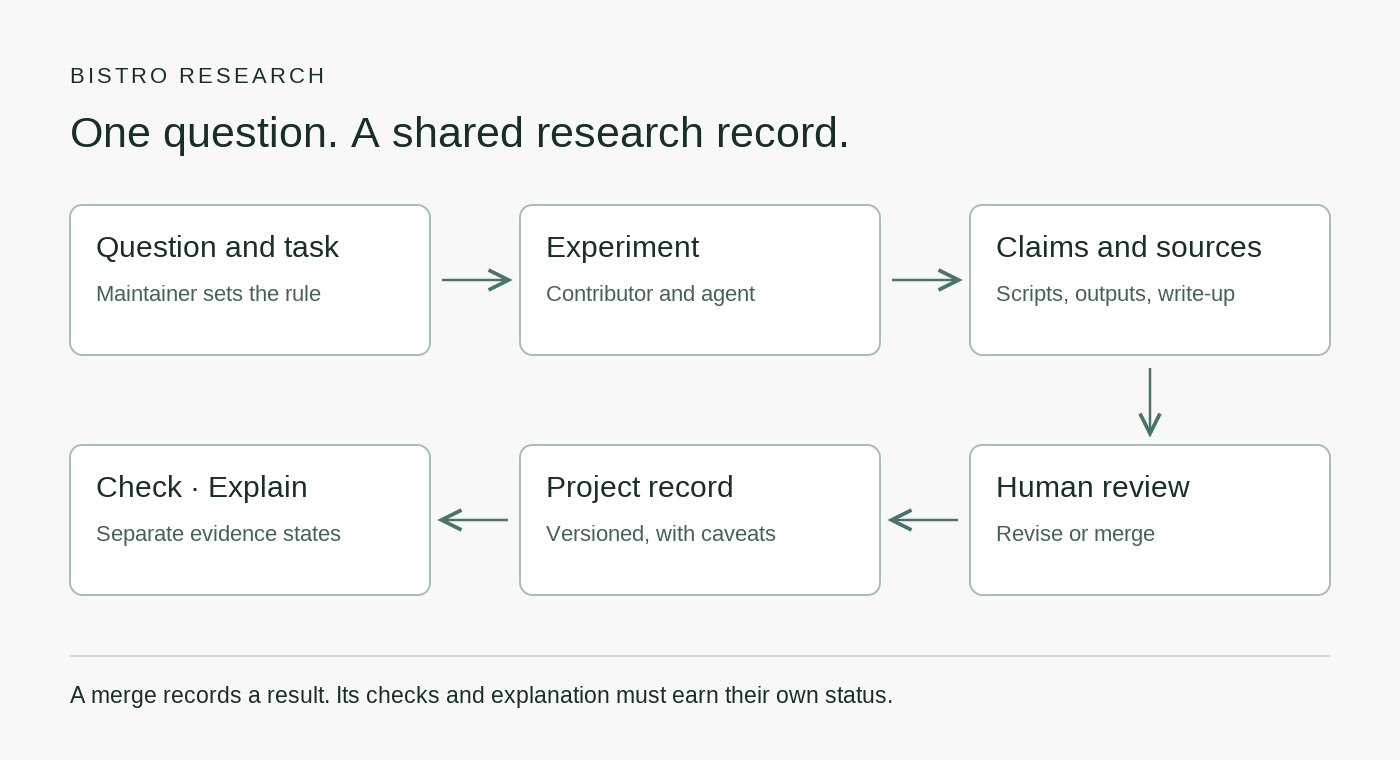
A simplified view of the workflow. Review can return work for revision; recording a result does not automatically upgrade its evidence status.
The project is a research graph
The persistent unit is a project with a question, a body of evidence and work still to do. Its research graph connects hypotheses, experiments, findings, scripts, datasets, sources and caveats. Proposals describe possible next experiments. A caveat can threaten a finding; a proposed task can address that caveat.
This makes a failed hypothesis useful. Its experiment, decision rule and limitations remain available to the next contributor. The project can accumulate knowledge without turning every completed task into a positive claim.
The implementation reads a project’s metadata from program.yaml, its graph from graph/research_graph.json, registered checks from claims.json, and articles from the project’s article directory. The graph uses the research-graph/1 schema. A separate structure view records concise summaries and which findings depend on earlier results.
Dependency has a specific meaning here. One finding can use another’s numbers or method; a different relationship records that an earlier result merely suggested a later question. If an input is superseded, the structure view can flag the results that depend on it. Refuting a hypothesis does not, by itself, invalidate every experiment it inspired.
The public Proof Atlas project illustrates the distinction between importing a record and checking it again. It carries the earlier research history, but explicitly identifies imported findings as the maintainer’s reported results, not results independently rerun on Bistro. Its open tasks include checking the public packet audits. The compiled proof article retains the scope of the original structural measurements.
One task, with a question and a limit
An ordinary contribution starts by choosing a task and a spending limit. The agent claims the task, reads its brief and works locally through the Model Context Protocol, or MCP. The server exposes operations such as claim_task, task_brief, report_usage, submit_result and submission_status.
The task brief supplies the question, hypothesis, decision rule and relevant project context. A versioned working guideline has a hash that the submission returns, so the server can identify which instructions the contributor received. Once work has started, the project’s task-editing rules protect the question and acceptance rule from being silently rewritten around the outcome.
During the work, the agent reports cumulative usage. The server keeps totals from decreasing across resumed sessions and responds with an instruction to continue, warn or stop. Contributors can also stop a session or give the task back. A claim has an expiry; an interrupted contribution can be resumed where the task is still available.
The spending limit has a practical boundary: usage from a contributor’s own model account is reported by the agent. Bistro does not independently meter that provider’s bill, and a stop takes effect through subsequent calls and the agent’s cooperation. Funded work on Bistro’s infrastructure has a separate cost guard that reserves estimated spend against the project pool and run and daily caps.
The funding ledger attributes recorded costs to the project’s oldest unspent donations, splitting a cost across donations when necessary. A contributor’s own compute is recorded separately and is not charged to that pool. Pledges, received money and reported token usage consequently describe different quantities.
At submission, the result includes the finding, its claims, files, article, sources and usage manifest. A submission enters a staged state. Review can request changes, and a revision updates the same proposal rather than creating an unrelated result.
The contributor’s agent can prepare and submit work. Decisions to merge, accept or sign it belong to people. There are narrow exceptions to independent merging: for example, a sole maintainer can merge their own agent’s result, with that fact recorded explicitly. Such a merge cannot serve as evidence of an independent review.
What an executable claim checks
A script claim identifies a stored program and the output it is expected to produce. The checker runs the Python script and reads its last nonempty standard-output line as JSON. Expected object fields must be present; lists are compared element by element; numerical values are compared within the registered tolerance. Tolerances are bounded by the server.
This is more precise than attaching a script somewhere near a paragraph. A metric can name both its claim and the path to its value inside the script’s JSON output. The evidence layer upgrades that metric only when the check passes, the output contains the stated value and the result has no recorded concern that blocks the upgrade.
The implementation distinguishes these evidence states:
| State | What it records |
|---|---|
| Reported | The author supplied the value; it has not earned a stronger status. |
| Re-executed | A stored script produced the matching value again. |
| Replicated | Separate contributors agreed through independently checked runs and different scripts, under the replication rules. |
| Machine-proved | A registered formal claim passed its Lean check. |
A finding with several numerical metrics takes the weakest of their evidence states. Checking one headline number therefore does not upgrade every number in the finding. Replication checks compare contributors, verdicts, overlapping metrics and script fingerprints; these can detect some duplication, but cannot prove that two analyses were independently conceived.
Re-execution establishes repeatability under a particular check. The same script can reproduce an incorrect denominator, a biased sample or a mistaken interpretation. Bistro includes screening for suspicious scripts and lets a reviewer’s agent attach code-reading notes about inputs, exclusions and calculations. Those are aids to review; they cannot establish that a scientific method is sound.
The Lean path asks the pinned environment for the declaration’s type and its axiom dependencies. It rejects failed probes and dependencies outside the allowed standard axioms, including sorryAx. This checks a formal declaration within that environment. A separate statement review is needed to establish that the declaration says what the research question intended; a theorem about a restricted case does not acquire a broader meaning by passing the kernel.
There is also an operational distinction between Merge and Accept with a rerun. Merging a proposal puts its contents in the versioned project record. The acceptance path can execute submitted claims, but is refused when submission execution is disabled. In the inspected configuration, production defaults keep that execution off pending the required isolation. Existing registered claims have their own verification path. A visible “Re-verify” control is therefore not evidence that every submitted script was automatically rerun before its merge.
The public worked example shows how the question, analysis, stored checks and provisional finding fit together. Its cancer-trial study is presented as inconclusive against its chosen threshold. That is an example of the site’s recorded workflow, not an independent replication performed for this article.
Checked and explained are separate
A result can be formally checked and still be difficult to understand. Bistro models explanation as another task.
The writer answers three questions: what was found and under which assumptions; which step makes it hold and where that step is supported; and what would show it wrong. The explanation must refer to the existing record rather than introduce a new experiment or new numerical claims.
A reader other than the writer then answers the same questions from the explanation. A maintainer compares that review with the record before merging the explanation. The finding records the writer and reader and gains a separate explained state.
This is an implemented review mechanism, not a measurement of general human comprehension. It records a particular reader’s successful review. Whether the explanations help a wider population understand difficult proofs or analyses remains an empirical question.
How the application is built
The current code is a web application with a Python research backend and several interfaces to the same project record.
| Part | Implementation and responsibility |
|---|---|
| Website | Next.js and React render project pages, findings, articles, graph views and contributor controls. |
| Backend | Django owns the API, accounts, permissions, task lifecycle, reviews and accounting. |
| Agent interface | A Python MCP server exposes task and project operations with access checks. |
| Research content | Project files carry metadata, graph data, claims and articles. Versioned proposals and commits preserve changes to the record. |
| Operational data | Django models store people, roles, runs, reviews, costs and audit events. The database configuration supports PostgreSQL; local development defaults to SQLite. |
| Deployment | The application image packages the Next.js server, Django and MCP processes. Deployment scripts also define jobs for research steps and checks; production project files can be mounted from Cloud Storage. |
The frontend forwards API and MCP requests to their backend processes. This keeps browser sessions and server-side permission checks within one application boundary. The hosted versioned record uses Dulwich, a Python Git implementation, with Git objects and references stored through Django models. A GitHub-backed record is also implemented behind a configuration flag; its presence in the code does not establish that it is enabled for a live project.
Articles require a further boundary. Reviewed content shipped with the application may be compiled as MDX. Imported text and contributor submissions are rendered as Markdown rather than being allowed to introduce server-executed MDX code.
The code also includes a funded research harness with grounding, planning, building, verification and delivery stages. It uses the Claude Agent SDK and Gemini integrations. This coexists with the contributor workflow: bringing an agent to Bistro does not require the website to run that agent itself.
What remains to establish
The application implements much of the coordination machinery: bounded tasks, versioned submissions, review, claim checks, evidence labels and explanation tasks. That machinery makes the evidence easier to inspect. Its scientific value still depends on the questions, source data, checks and reviewers attached to each project.
Several capabilities are deliberately gated. Unattended runners, agent teams, GitHub-backed records and execution of newly submitted scripts have separate switches or prerequisites. Their implementation should not be read as a claim that every feature is open or enabled in production. Likewise, a recorded cost is an accounting entry, with contributor estimates kept distinct from a provider invoice or money received by a project.
The source inspection behind this article was made on 28 November 2026. It establishes the implementation described here, not a fresh execution of every research result, a security audit or a benchmark of research quality.
The useful starting point is one project: read its question, inspect a claim and its latest check, follow an unresolved caveat, and look at the task proposed to address it. Browse Bistro Research or see how to contribute with an agent.